

About the National BPS Coalition

Americans spend more than 90% of our time in buildings. Our structures shape our health, our economic opportunities, and our ability to stay safe during extreme weather.  The energy we use inside buildings affects our cost of living, our utility infrastructure, and our ability to meet climate commitments. In most cities, buildings are the largest contributor to greenhouse gas emissions.

The National Building Performance Standards Coalition is a voluntary group of state and local governments that, in January 2025, reaffirmed their commitment to building performance policies and programs. The Coalition continues the momentum of recent building performance standard (BPS) adoptions to accelerate better buildings nationwide, especially for communities facing the greatest challenges. By centering community voices and needs, BPS can drive retrofits and align emissions, electrification, and equity goals. Together, we can create healthier, more affordable, and more climate-resilient buildings, while spurring economic growth.

The Institute for Market Transformation supports the Coalition and its members by providing peer knowledge-sharing and collaboration forums, technical and policy analysis, localized policy design, and support for stakeholder engagement.

Coalition Participants and Their Commitments
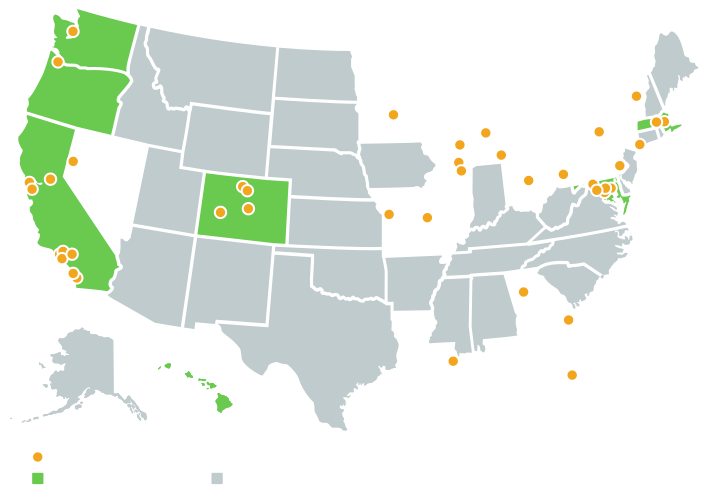
NationalBPSCoalition SVG Map

America’s state and local governments commit to drive equitable building energy and climate policy

Governments across the nation launch efforts to inclusively design and implement building performance standards and complementary programs and policies

As mayors, governors, and county executives, we are joining in coalition, with a heightened ambition to unlock the full human and climate potential of our built environment. Aligning our emissions reduction and equity goals with building upgrade and retrofit programs, we commit to lead the effort to decarbonize America’s building sector. We will identify and act on the pre-requisites for building performance standards or other complementary policies, and will work to advance legislation and/or regulation. In doing so, we will work with stakeholders, especially frontline communities, to design and implement programs and policies that will address our health, energy, housing affordability, and climate needs in buildings. Forging a community of practice in policy innovation, we commit to sharing our results and best practices with one another.

The time for action is here, and we invite our peers nationwide to partner with us.

Signed,

Christopher Taylor
Mayor, City of Ann Arbor

Gavin Buckley
Mayor, City of Annapolis

Torre
Mayor, City of Aspen

Keisha Lance Bottoms
Former Mayor, City of Atlanta

Jesse Arreguín
Mayor, City of Berkeley

Michelle Wu
Mayor, City of Boston

Aaron Brockett
Mayor, City of Boulder, CO

Andrew McAllister
Energy Commission Commissioner, State of California

Louis A. DePasquale
City Manager, City of Cambridge

Lori Lightfoot
Mayor, City of Chicago

Mary Casillas Salas
Mayor, City of Chula Vista 

Jared Polis
Governor, State of Colorado

Andrew J. Ginther
Mayor, City of Columbus

Michael B. Hancock
Mayor, City of Denver

Daniel Biss
Mayor, City of Evanston

Jeni Arndt
Mayor, City of Fort Collins

Muriel Bowser
Mayor, District of Columbia

Rosalynn Bliss
Mayor, City of Grand Rapids

Josh Green, M.D.
Governor, State of Hawaiʻi

Svante Myrick
Mayor, City of Ithaca

Quinton Lucas
Mayor, Kansas City

Sheila Kuehl & Holly Mitchell
Supervisors, Los Angeles County

Eric Garcetti
Mayor, City of Los Angeles

Wes Moore
Governor, State of Maryland

Cavalier Johnson
Mayor, City of Milwaukee

Jacob Frey
Mayor, City of Minneapolis

Marc Elrich
County Executive, Montgomery County, MD

Anne Watson
Mayor, City of Montpelier

LaToya Cantrell
Mayor, City of New Orleans

Eric Adams
Mayor, New York City

Tina Kotek
Governor, State of Oregon

Buddy Dyer
Mayor, City of Orlando

Jim Kenney
Mayor, City of Philadelphia

Ed Gainey
Mayor, City of Pittsburgh

Ted Wheeler
Mayor, City of Portland

Angela Alsobrooks
County Executive, Prince George’s County, MD

Hillary Schieve
Mayor, City of Reno

Darrell Steinberg
Mayor, City of Sacramento

Tishaura O. Jones
Mayor, City of Saint Louis

Todd Gloria
Mayor, San Diego

London N. Breed
Mayor, City and County of San Francisco

Gleam Davis
Mayor, Santa Monica

Van R. Johnson, II
Mayor, City of Savannah

Bruce Harrell
Mayor, City of Seattle

Jay Inslee
Governor, State of Washington

Sepi Shyne
Mayor, City of West Hollywood

By moving toward efficient, renewably powered buildings with the support of our stakeholders, we are showing how local governments can work with their communities to pass bold, achievable, and equitable policies. This coalition is the start of a climate-safe future for all.”

Mayor Michael Hancock
Denver, Colorado

Frequently Asked Questions

  • What is the National Building Performance Standard (BPS) Coalition?

    The National Building Performance Standards Coalition is a nationwide group of local and state governments committed to improving building performance and fighting climate change. They are doing this by inclusively designing and implementing equitable building performance standards and complementary programs and policies. The Coalition has grown to 49 governments, including 7 states and 42 localities and continues to accept new members. The Coalition was launched in 2022 under President Biden with the support of the Institute for Market Transformation (IMT).In 2025, IMT assumes sole management of the Coalition to coordinate member engagement and support.

  • Why buildings?

    Buildings are central to our lives, economy, and environment. Their performance affects indoor and outdoor air pollution and the health of our communities. The energy buildings use is a significant cost to households and businesses—and energy costs disproportionately burden low-income communities.

    Buildings account for about a third of U.S. emissions and about 75% of electricity consumption. Climate researchers calculate that to hold global temperature rise below 2 degrees (Celcius) and avoid the worst impacts of climate change, the U.S. and other developed countries must cut emissions dramatically by 2030. The math is clear: meeting climate goals requires significant emissions reductions from buildings, achieved through improved efficiency and increased use of clean energy.

  • What are Building Performance Standards?

    Building performance standards (BPS) are state and local laws that require existing buildings to achieve minimum levels of energy or climate performance. Working in tandem with new construction energy codes, BPS empower state and local leaders to deliver on energy, climate, and equity goals through improved operations and accelerated retrofits.

    A BPS is an innovative policy approach for building efficiency and decarbonization.It is an outcome-based policy that requires, by specific deadlines, existing buildings of specified sizes and types achieve quantified standards of measured building performance across one or more metrics—such as energy use, water use, and/or greenhouse gas emissions. The policies often set long-term and interim targets to provide regulatory certainty and provide multiple compliance pathways to offer flexibility, especially for affordable housing or other community priority building types.

  • Why place requirements on private businesses and buildings?

    Buildings are a major driver of energy costs, and affordability is a core concern for owners, tenants, businesses, utilities, and governments alike. For decades, most jurisdictions have relied primarily on voluntary incentives to improve building performance. Those programs help, but experience from around the country shows they don’t deliver improvements at the speed or scale needed to lower bills, reduce emissions, and protect public health—especially in communities that have faced the highest energy burdens and worst air quality.

    A BPS sets clear, mandatory outcomes—while preserving flexibility in how building owners meet them. Owners can choose the operational improvements, equipment upgrades, electrification pathways, and financing strategies that make the most sense for their portfolios. Strong policies also recognize that not every building can upgrade overnight, so many programs establish long-term standards with interim targets that ramp over time. This creates market certainty: it helps owners plan capital investments, helps service providers scale, and discourages spending on long-lived, inefficient systems that lock in high operating costs.

    Improving efficiency and performance also helps reduce strain on the grid, lowering system costs over time and reducing outage risk—outcomes that benefit building owners and the broader economy.

  • What is the estimated impact?

    As of 2025, Coalition members represent approximately 25% of the nation’s commercial building stock. IMT estimates that if Coalition members adopt and implement BPSretrofit policies and related programs at scale, impacts through 2040 could include:

    Better buildings for over 90 million people

    $132 billion cumulatively invested in building retrofits in Coalition jurisdictions through 2040

    676 million metric tons (MMT) of CO₂e cumulatively eliminated through 2040

  • How does the National BPS Coalition work?

    IMT has managed and led the Coalition’s growth since its launch. In 2025, federal technical assistance networks and support for BPS policy work were paused or terminated, increasing the importance of sustained Coalition infrastructure, shared resources, and peer learning.

    The Coalition supports members through a model that emphasizes:

    Peer learning among jurisdictions

    Policy design and implementation support to advance equitable, enforceable building policies

    Community engagement approaches that center communities most impacted by climate change in shaping solutions

  • How is the Coalition’s work different from a city or state’s sustainability plan?

    BPS policies focus specifically on building performance, while sustainability plans may also cover transportation, land use, waste, and other sectors. The Coalition also places particular emphasis on community-centered governance and equitable outcomes alongside technical policy design. BPS plans are designed to align into comprehensive City planning efforts for not only sustainability, but also workforce development, strategic land use, zoning, economic growth, and countless other elements.

  • Can my state, city or county participate in the Coalition?

    If the commitment statement in “Coalition Participants and Their Commitments” aligns with your jurisdiction’s building-sector roadmap, priorities, and capacity, please use the “Contact Us” option below to discuss participation expectations and next steps. The chief executive (e.g. mayor, county executive, governor) for your jurisdiction must sign on.